
On By foeindia In Webinars (please find the pdf link below)
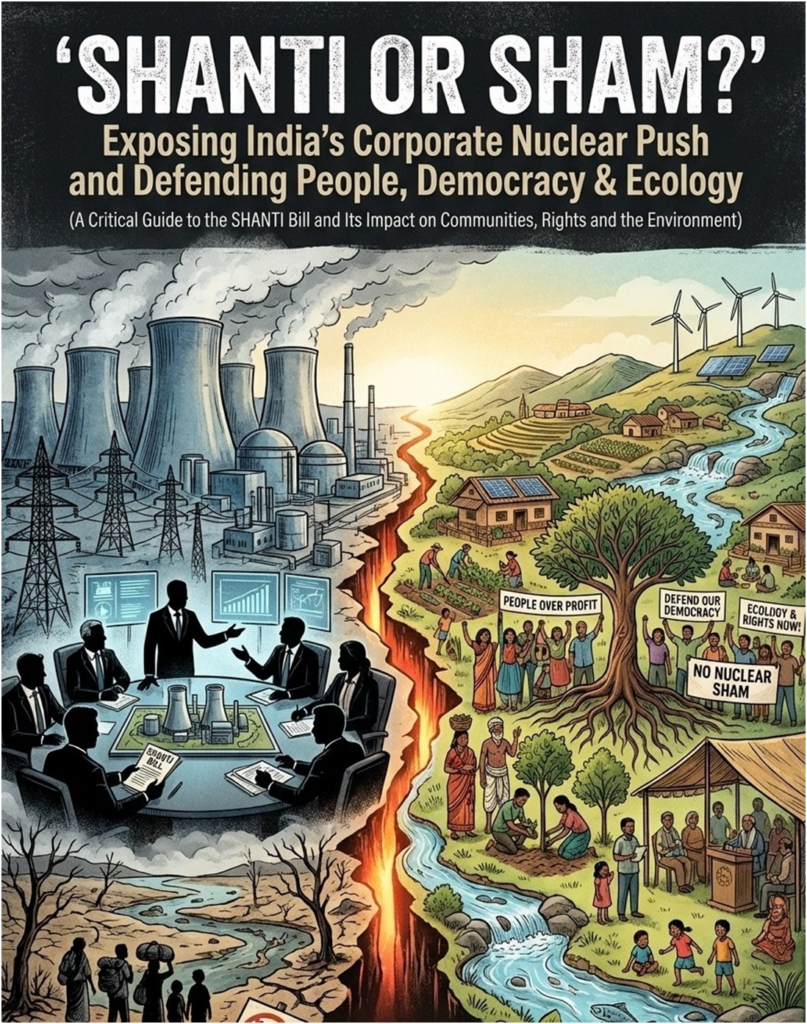
On March 11, marking the anniversary of the Fukushima nuclear disaster, Friends of the Earth India is releasing a new handbook titled: “SHANTI OR SHAM? Exposing India’s Corporate Nuclear Push and Defending People, Democracy & Ecology (A Critical Guide to the SHANTI Bill and Its Impact on Communities, Rights and the Environment).”
Fifteen years after the Fukushima disaster and four decades after the Chernobyl disaster, the world continues to face the devastating consequences of nuclear power — displacement of communities, contamination of land and water, loss of livelihoods, and long-lasting impacts on health and ecosystems. Yet governments and corporations are aggressively promoting a renewed nuclear expansion, falsely presenting nuclear energy as a “clean” and “climate-friendly” solution.
In India too, the government has announced a new Nuclear Energy Mission with major public investment and proposals for Small Modular Reactors (SMRs) in multiple locations, while opening the sector to private operators and corporate interests. This direction raises serious concerns about safety, democratic accountability, ecological protection, and the rights of affected communities.
In this context, the newly released handbook critically examines the proposed SHANTI Bill and its implications for India’s nuclear policy, democratic governance, public safety, and ecological justice. It also provides analysis, evidence, and perspectives that can support people’s movements and civil society groups resisting nuclear expansion across the country.
The Sustainable Harnessing and Advancement of Nuclear Energy for Transforming India (SHANTI) Bill, 2025, was passed by both houses of the Indian Parliament during the Winter Session in December 2025.
Here is the timeline:
• Passed by Parliament: The Lok Sabha passed the bill on December 17, 2025, and the Rajya Sabha passed it on December 18, 2025.
• Gazetted: The SHANTI Act received the assent of the President of India on December 20, 2025, and has been Gazetted (Gazette Notified).
• Force Status: As of February 2026, while the Act is gazetted, the government has not yet notified the specific timelines for framing of Rules, Regulations, policies, and the final implementation of its provisions.
• Current Situation: The Act is meant to repeal the Atomic Energy Act of 1962 and the Civil Liability for Nuclear Damage Act of 2010 to allow private sector participation in nuclear power generation. It is currently in the phase where the government is empowered to draft the necessary rules for effective enforcement of safety, security, and interagency coordination during radiation emergencies.
Key Features of the SHANTI Act (Once Fully Implemented):
• Private Participation: Allows Indian companies and joint ventures to build, own, and operate nuclear power plants (formerly a government monopoly).
• *Statutory Regulator*: Grants formal statutory status to the Atomic Energy Regulatory Board (AERB).
• Liability Overhaul: Replaces the flat liability cap with a graded liability structure based on reactor capacity, increasing the maximum operator liability to INR 3000 crores for certain reactors.
• RTI Override: Section 39 of the Act excludes certain “restricted” nuclear-related information from the Right to Information (RTI) Act, 2005.
• Foreign Participation: While foreign companies cannot directly operate plants, they can participate in partnerships through Indian-incorporated entities.